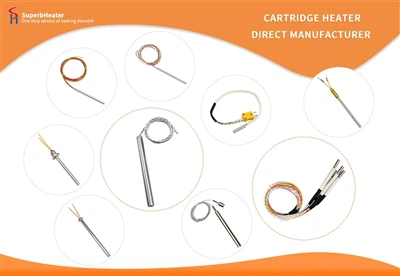
Many industrial teams struggle with inefficient heating, frequent heater replacements, and high maintenance costs-issues often caused by poor heat transfer and difficult installation/removal. Traditional solid-sheath cartridge heaters have been the standard for decades, but split-sheath designs offer a better solution, addressing these pain points while improving performance and reducing long-term costs. Understanding how split-sheath heaters work and their key benefits can help teams make better decisions and optimize their heating systems.
Split-sheath cartridge heaters differ from traditional solid-sheath heaters in one key way: their outer sheath is split along its length, allowing it to expand and contract with temperature changes. This simple design modification solves two of the biggest problems with solid-sheath heaters: poor heat transfer and difficult removal. According to industry experience, split-sheath heaters deliver better performance, longer service life, and easier maintenance than traditional designs.
The primary benefit of split-sheath heaters is improved heat transfer. When energized, the split sheath expands slightly, creating a tight, uniform contact with the borehole. This eliminates air gaps that block heat transfer in solid-sheath heaters, allowing heat to transfer more efficiently from the heater to the surrounding metal. Better heat transfer means the heater doesn't have to work as hard to reach the target temperature, reducing internal coil temperature by up to 100°C. This lowers oxidation rates, extends service life, and reduces energy consumption.
Longer service life is a direct result of improved heat transfer. Split-sheath heaters typically last 25,000 hours or more-12 times longer than the industry-standard 2,000 hours for solid-sheath heaters. This is because the lower internal coil temperature slows aging and oxidation, preventing premature burnout. For high-demand applications (such as semiconductor testing or medical devices), this translates to years of reliable operation without replacements, reducing maintenance costs and downtime.
Easy removal is another major advantage. Traditional solid-sheath heaters can seize in the borehole after repeated heating and cooling cycles, making removal difficult and often damaging the heater or the host component (such as a mold or test socket). Split-sheath heaters contract when de-energized, allowing for easy, slide-out removal-guaranteed never to seize. This saves time during maintenance and reduces the risk of damage to expensive equipment.
Uniform heating is also improved with split-sheath designs. The tight contact with the borehole ensures heat is transferred evenly across the entire length of the heater, eliminating hot spots and cold spots. This is critical for precision applications such as injection molding, semiconductor testing, and medical devices, where uniform temperature control is essential for product quality. Traditional solid-sheath heaters often have uneven contact due to air gaps, leading to inconsistent heating and poor performance.
Split-sheath heaters are also more forgiving of minor borehole imperfections. Traditional solid-sheath heaters require precise borehole sizing to ensure a tight fit, but split-sheath heaters expand to fill small gaps, making them ideal for applications where borehole precision is difficult to achieve. This reduces installation time and the risk of fit-related issues, such as uneven heating or premature failure.
Cost savings are significant over the long term. While split-sheath heaters may have a slightly higher upfront cost than traditional solid-sheath heaters, their longer service life and lower maintenance costs more than offset this. Fewer replacements mean less downtime, lower material costs, and reduced labor costs for maintenance. For example, a split-sheath heater that lasts 25,000 hours replaces 12 solid-sheath heaters (each lasting 2,000 hours), saving thousands of dollars in replacement costs alone.
Real-world applications highlight the benefits of split-sheath heaters. Semiconductor test sockets use split-sheath micro-cartridge heaters to maintain precise temperatures and ensure easy removal during maintenance. Injection molding dies use split-sheath heaters to improve heat transfer and reduce cycle times, while medical devices rely on them for reliable, long-life heating. In each case, split-sheath heaters deliver better performance and lower costs than traditional designs.
Split-sheath cartridge heaters are a game-changer for industrial heating applications, solving the most common pain points with a simple, effective design. Improved heat transfer, longer service life, easy removal, and uniform heating make them the ideal choice for precision applications where reliability and cost-effectiveness are critical. Every heating application can benefit from the advantages of split-sheath design, and customized solutions ensure the heater meets the specific needs of the application. Professional guidance can help select the right split-sheath heater and optimize installation for maximum performance and cost savings.