

I. Basic Characteristics of Stainless Steel Cartridge Heaters
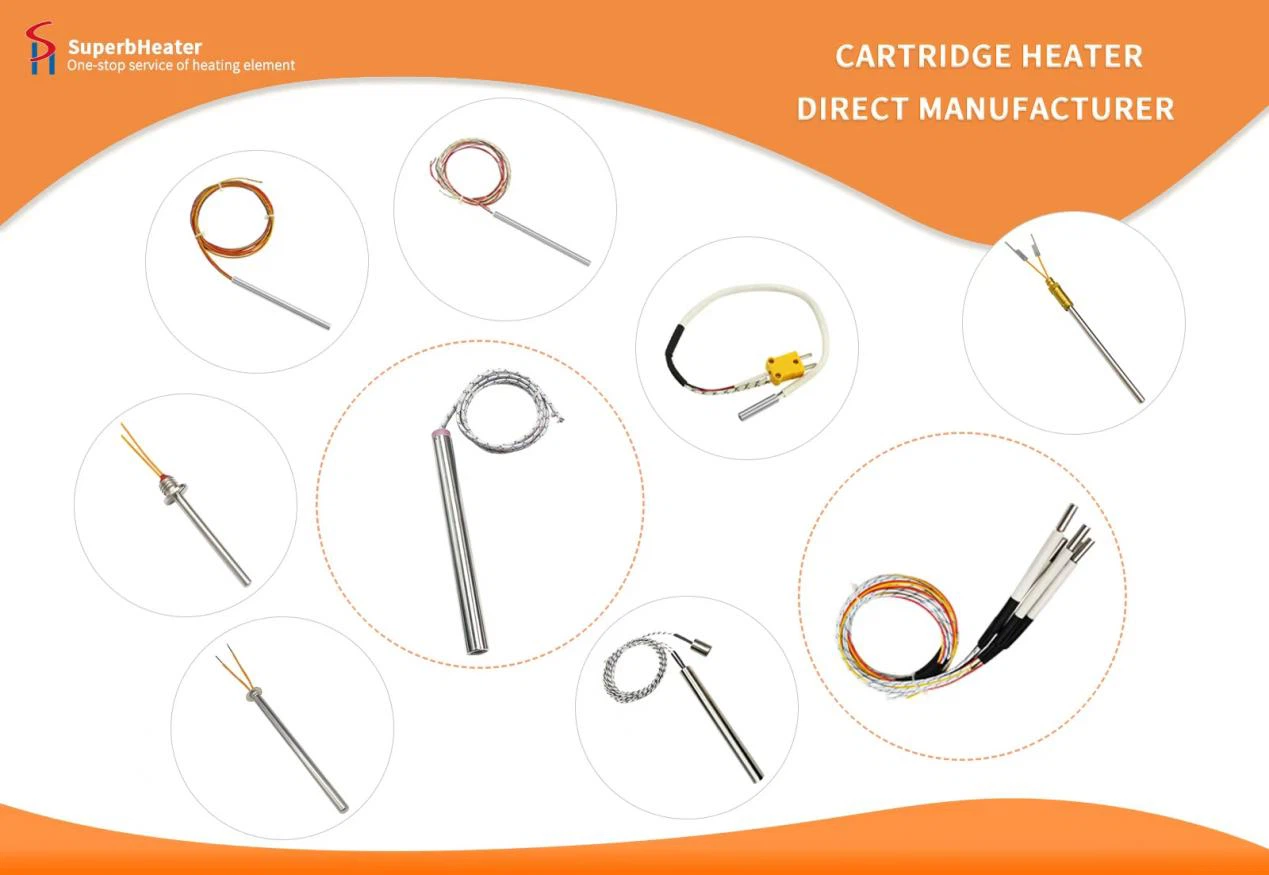
A stainless steel cartridge heater is an electric heating element manufactured by evenly distributing a spiral alloy resistance wire (such as nickel-chromium or iron-chromium alloy) along the central axis inside a metal tube sheath (stainless steel, copper, etc.). The remaining space is tightly filled with magnesium oxide, which provides excellent insulation and thermal conductivity. The assembly is then compacted through a swaging or reduction process. Among sheath materials, stainless steel is one of the most widely used in industrial heating due to its excellent mechanical properties and corrosion resistance.
II. Temperature Resistance Ranges of Different Stainless Steel Grades
1. 304 Stainless Steel
As a representative austenitic stainless steel, 304 has a standard operating temperature range of -196°C to 800°C. In an oxidizing atmosphere, it can withstand short-term exposure up to 900°C. However, prolonged use above 800°C can lead to intergranular corrosion and oxide scale spallation. Its high-temperature resistance primarily relies on the dense chromia (Cr₂O₃) protective film formed by its 18-20% chromium content.
2. 316 Stainless Steel
With the addition of 2-3% molybdenum, 316 stainless steel has an operating range of -196°C to 850°C. Molybdenum enhances pitting resistance, making its temperature resistance roughly 50°C higher than 304 in environments containing chlorides (e.g., seawater, salt spray). However, sigma phase embrittlement can occur above 900°C.
3. 310S Stainless Steel
Featuring high chromium and nickel content (Cr25Ni20), 310S is a typical high-temperature stainless steel capable of continuous operation at 1000-1150°C. It maintains good oxidation resistance up to 1000°C and has a relatively low coefficient of thermal expansion (18.5×10⁻⁶/°C), making it suitable for high-temperature heater construction.
4. Ferritic Stainless Steels
Grades like 430 stainless steel have a lower cost but a maximum service temperature limit of only ~650°C. At high temperatures, grain growth leads to increased brittleness, and their oxidation resistance is significantly inferior to austenitic grades.
III. Key Factors Affecting Temperature Resistance
1. Oxidation Kinetics
In high-temperature environments, a Cr₂O₃ scale forms on the stainless steel surface. When the temperature exceeds a critical value for the material (e.g., ~870°C for 304), this protective scale can transform into porous, non-protective Fe₂O₃. Experimental data shows the oxidation rate of 304 stainless steel at 900°C is 3-5 times higher than at 800°C.
2. Carbide Precipitation
In the 450-850°C range, chromium carbides (Cr23C6) can precipitate at grain boundaries, creating chromium-depleted zones. Using low-carbon grades (e.g., 304L) or adding stabilizing elements like titanium or niobium can mitigate this issue.
3. Creep Performance
When the temperature exceeds approximately 0.4 times the material's melting point (~510°C for 304), significant creep deformation begins. At 800°C, the creep rupture strength of 304 stainless steel is only about 1/20th of its room temperature strength.
IV. Performance Degradation at High Temperatures
1. Resistance Change Rate
Under continuous operation, the resistance of 310S stainless steel can increase by approximately 8-12% after 1000 hours, primarily due to a reduction in cross-sectional area caused by oxidation.
2. Thermal Efficiency Decline
Studies indicate that as the surface temperature rises from 800°C to 1000°C, the proportion of heat loss via radiation from a stainless steel heater increases from about 35% to 60%. Surface treatments (e.g., sandblasting, specialized coatings) can improve emissivity and counteract this.
V. Selection Guidelines
1. Below 500°C: 304 stainless steel is the preferred and economical choice.
2. 500°C to 900°C: Recommend using 316 or 321 (titanium-stabilized) stainless steel.
3. 900°C to 1100°C: Must select 310S or higher-grade alloys like 253MA (21Cr-11Ni-Si-Ce).
4. Above 1100°C: Consider nickel-based alloys such as Inconel 600.
VI. Important Usage Considerations
1. Temperature Gradient Control: Maintain a temperature difference between the heater sheath and the heated medium below 300°C to avoid thermal stress cracking.
2. Dry-Firing Limit: In dry, unsubmerged conditions (air), the surface temperature of a 304 stainless steel heater should not exceed 500°C.
3. Cooling Rate: During shutdown from high temperature, control the cooling rate to less than 100°C per minute.
4. Medium Compatibility: The presence of sulfur in the environment will lower the maximum temperature resistance of all stainless steels.
VII. Future Development Trends
New stainless steel materials like AL6XN (high-molybdenum nitrogen alloy) and austenitic grades like 254SMO can increase temperature resistance by approximately 100°C through elevated nitrogen content (0.2-0.3%) while maintaining excellent corrosion resistance. Nanocrystalline stainless steel coating technologies have the potential to increase the maximum service temperature of conventional 304 stainless steel by 150-200°C.
Conclusion
The actual temperature resistance of a stainless steel cartridge heater is a combined result of material properties, manufacturing quality, and operating conditions. Correct selection requires comprehensive consideration of factors including operating temperature, medium composition, and thermal cycling. For high-temperature applications, it is advisable to incorporate a 15-20% safety margin. With advancements in material science, the temperature limits of stainless steel cartridge heaters are continually being extended, providing more reliable and efficient solutions for demanding industrial heating applications.

 ,,
,,


